5 Wiring Mistakes That Could Start a Solar Fire (Be Careful!)
 Admin
Admin
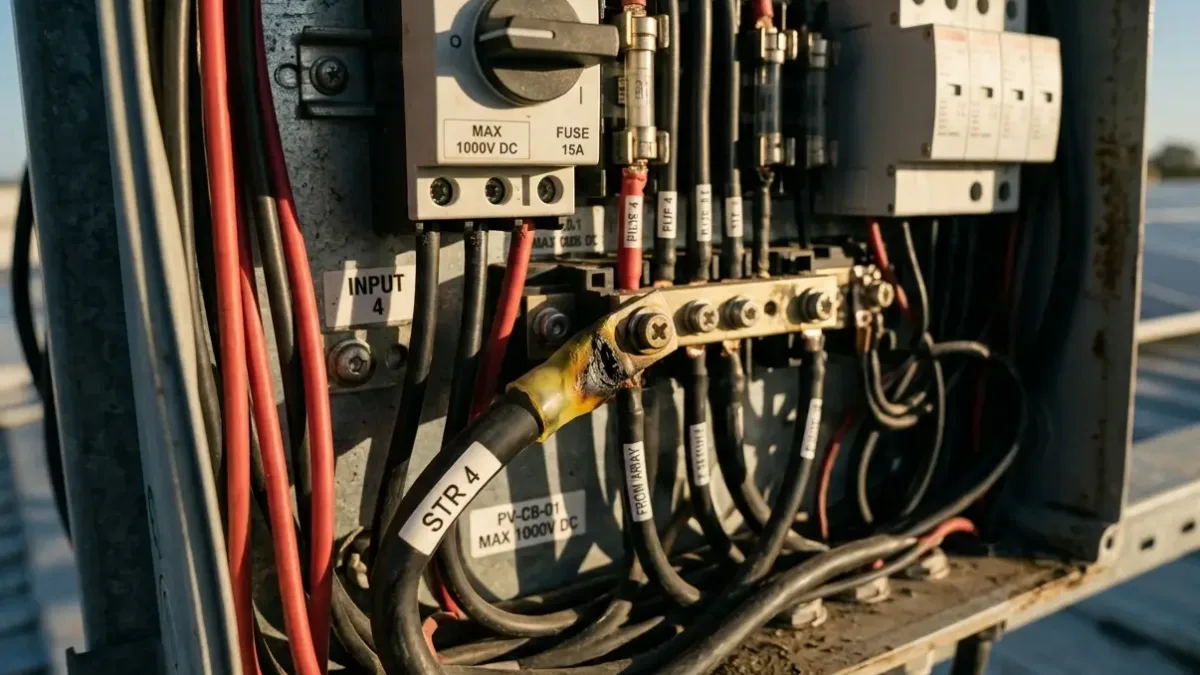
Solar energy is one of the cleanest, most reliable ways to power your home, and modern photovoltaic (PV) systems are built with impressive safety standards. Serious incidents are extremely rare. However, when electrical issues do occur in a solar setup, they almost always trace back to one culprit: preventable wiring oversights.
Unlike standard AC electricity in your home outlets, solar panels produce Direct Current (DC). DC electricity behaves differently—it is continuous, high-voltage, and far less forgiving of physical defects. The good news? Every major solar wiring hazard is entirely avoidable with proper technique and the right components.
Whether you are auditing your existing rooftop array, building a DIY off-grid setup, or entering the solar installation field, avoiding these five critical wiring mistakes will keep your system running safely for decades.
1. Using Undersized or Non-PV Rated Wires
Why It Happens
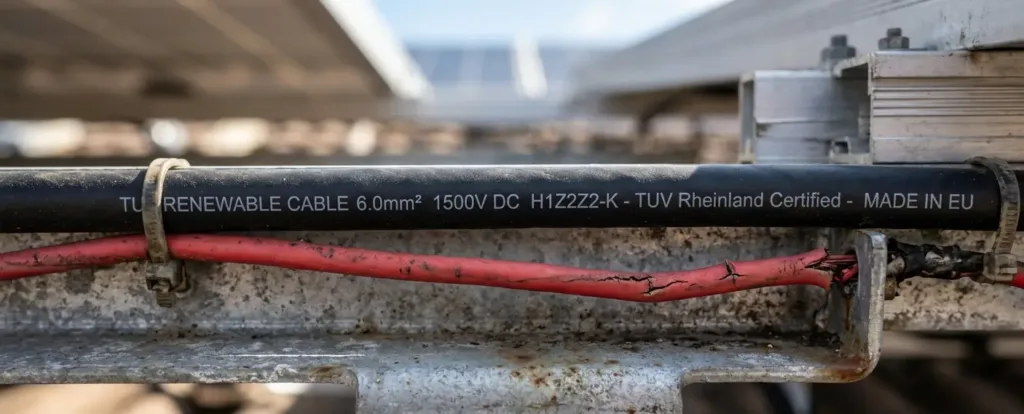
When selecting cables, it is tempting to use standard electrical wire or under-gauge wire that is cheaper or easier to route.
The Risk
Think of electrical wire like a water pipe. Voltage is the water pressure, and current (amperage) is the volume of water flowing through. If you try to force a massive volume of water through a narrow straw, pressure builds up and friction increases. In electrical terms, forcing high current through a wire that is too thin creates excessive electrical resistance.
Resistance generates heat. Over time, heat degrades insulation, melts jacket material, and can easily ignite nearby roof materials or attic insulation. Furthermore, using standard wire instead of PV-rated wire (like standard USE-2 or PV Wire) exposes the cable to degradation from extreme outdoor temperatures and intense UV radiation.
The Fix
- Calculate Wire Gauge (AWG): Always size conductors based on maximum current, continuous duty factors (125% multiplier per NEC requirements), and total circuit length to minimize voltage drop below 2%.
- Use Only Sunlight-Resistant PV Wire: PV-rated cables feature thick, cross-linked insulation designed specifically to endure high DC voltages, outdoor thermal cycling, and direct UV exposure.
Pro Safety Tip: Never guess wire size based on short distances. Always consult a certified wire ampacity chart specifically rated for 90°C outdoor wet locations.
2. Poor Crimping or Loose MC4 Connectors
Why It Happens
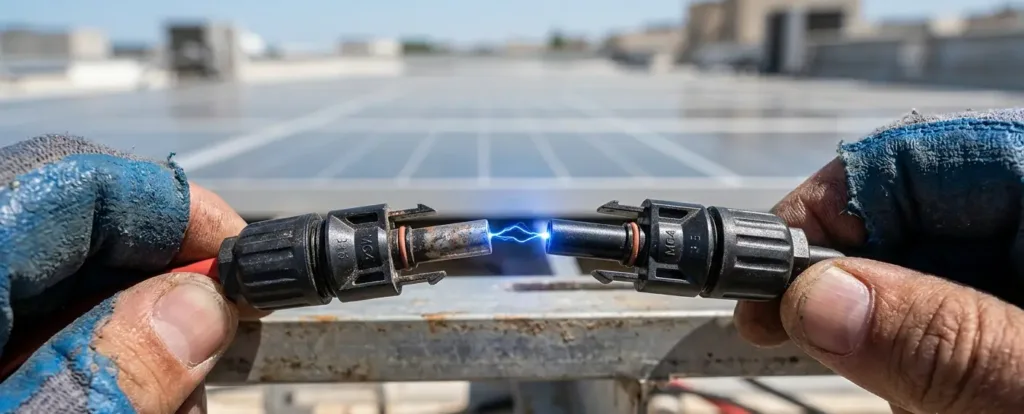
MC4 connectors are the industry standard for joining solar panel cables. However, improper assembly—such as hand-squeezing pins with standard pliers, mixing mismatching connector brands, or failing to snap them completely together—is shockingly common.
The Risk
A loose or poorly crimped connector creates high contact resistance. As electricity struggles to jump across a bad connection, it creates intense localized heat.
Even worse, Direct Current does not cross zero voltage 120 times a second like Household AC does; once a DC arc starts, it does not self-extinguish easily. A tiny gap in a high-voltage DC connector can form a continuous, burning electric arc reaching temperatures over 3,000°C (5,400°F)—more than hot enough to melt metal and ignite surrounding materials.
The Fix
- Use Dedicated Ratcheting Crimp Tools: Never use standard pliers or automotive crimpers for MC4 pins. Use a ratcheting MC4 crimp tool designed for exact pin dimensions.
- Avoid “Cross-Mating”: Do not plug Brand A MC4-compatible connectors into Brand B connectors. Microscopic manufacturing tolerances vary between brands, creating high-resistance points.
- Listen for the Click: Ensure connectors fully snap together and lock tightly with proper cable glands to seal out moisture.
3. Improper System Grounding
Why It Happens
Grounding is often treated as an afterthought because a solar array can appear to operate normally even if it isn’t grounded. Installers sometimes fail to bond panel frames together or forget to tie the array into the main household grounding electrode system.
The Risk
Solar panels are installed on roofs—the highest point of a structure—making them vulnerable to static build-up, induced surges from nearby lightning strikes, and internal ground faults.
Without a solid, continuous path to the earth, stray electrical current has nowhere to go. If a hot wire chafes against a panel frame, the entire aluminum racking system can become energized. Anyone touching the rack receives a severe shock, and static build-up can jump to adjacent metal flashing, sparking a fire.
The Fix
- Establish Equipment Grounding Conductors (EGC): Ensure every panel frame and racking rail is electrically bonded using ground lugs, star washers, or specialized grounding clips (like WEEB clips).
- Tie Into Main Earth Ground: Connect the solar array’s grounding system directly to your home’s main grounding electrode system using solid copper wire.
4. Skipping DC Breakers, Fuses, or Isolators
Why It Happens
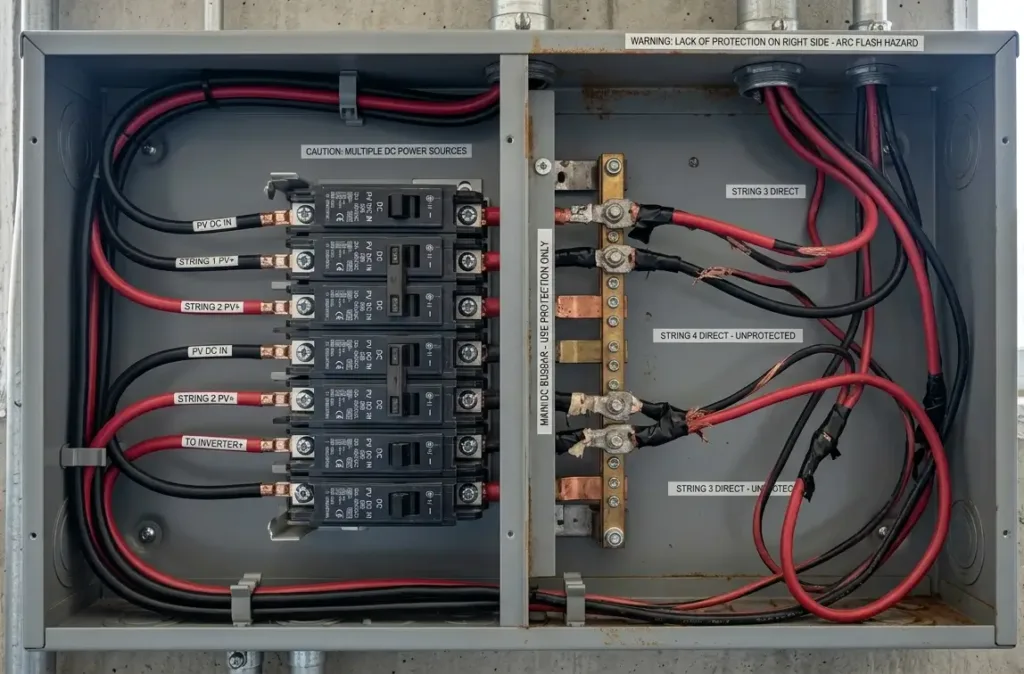
To save costs or simplify wiring, DIY builders and inexperienced installers sometimes run solar panel strings straight into charge controllers or inverters without installing intermediate overcurrent protection or manual disconnect switches.
The Risk
If a short circuit occurs anywhere along the cable run, solar panels will continue pushing full current into the fault as long as the sun is shining. Without a fuse or breaker to interrupt the circuit, the wire will rapidly overheat, melt its jacket, and start an electrical fire.
Additionally, without a accessible DC isolator switch near the array or inverter, emergency responders or technicians cannot safely turn off the live DC current during maintenance or a house fire.
The Fix
- Install In-Line String Fuses: Use properly rated DC fuses (typically 15A–30A depending on panel specifications) for parallel solar strings to protect individual panel leads from reverse current.
- Add DC Circuit Breakers & Isolators: Place a dual-pole DC-rated circuit breaker/isolator between the PV array and the inverter or charge controller.
- Never Use AC Breakers for DC Circuits: Standard AC breakers cannot extinguish a DC arc and will fail catastrophically under load. Always verify the breaker explicitly says “DC Rated.”
5. Unprotected Wire Routing & Poor Strain Relief
Why It Happens
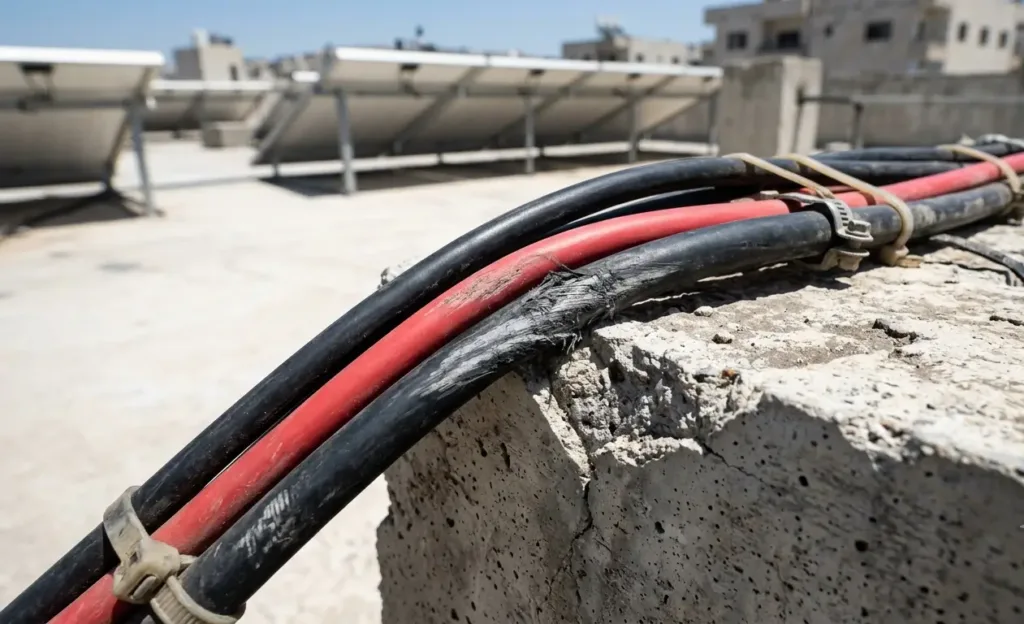
Cables are left dangling beneath panels, draped loosely over sharp roof tile edges, or zipped tightly around structural members without room for thermal expansion.
The Risk
Roofs are harsh environments. Over time, wind causes dangling wires to scrape repeatedly against rough shingles or sharp metal racking edges. Temperature shifts cause metal and wire to expand and contract daily.
Eventually, mechanical friction wears away the outer protective jacket, exposing bare metal conductors. Once exposed to rain or damp air, short circuits and arcing become inevitable.
The Fix
- Secure Cables Properly: Use UV-resistant stainless steel cable clips or heavy-duty outdoor-rated cable ties to fasten wires neatly along panel frames and racking rails.
- Protect Sharp Edges: Use conduit (like EMT or flexible non-metallic conduit) whenever wires pass over roof ridges, enter attics, or run down exterior walls.
- Provide Drip Loops and Strain Relief: Leave slight slack in cables before they enter junction boxes so water runs off naturally and tension doesn’t pull wires out of terminals.
Pro Safety Tip: Keep all wiring tucked cleanly underneath the solar modules, elevated off the roof surface. This protects cables from pooling water, debris buildup, and animal chewing.
Quick Safety Checklist
Before powering on or approving any solar installation, perform a quick visual and physical audit using this safety checklist:
- [ ] Wire Specs: All outdoor DC cables are sunlight-resistant PV Wire of the correct AWG gauge.
- [ ] Connections: All MC4 connectors are from the same manufacturer, crimped with specialized tools, and fully locked.
- [ ] Grounding: Panel frames, racking, and enclosures are bonded and tied to an earth ground.
- [ ] Protection: Correctly rated DC breakers, fuses, and rapid-shutdown/isolator switches are installed.
- [ ] Routing: Wires are elevated off the roof surface, secured with UV clips, and protected in conduit across sharp edges.
Final Thoughts: Power Your Home with Confidence
Solar energy remains one of the safest, most dependable investments you can make for your property. Recognizing these common wiring traps isn’t meant to scare you—it’s meant to empower you. By adhering to basic electrical standards, selecting quality components, and refusing to take shortcuts on safety, you ensure your solar investment delivers clean power risk-free for decades.
If you suspect your system has loose connections, damaged wire insulation, or improper grounding, do not attempt to service high-voltage DC circuits while the sun is shining. Contact a licensed, certified solar electrician to inspect and test your array safely.
Have you recently audited your solar array’s wiring, or are you planning a new installation? Feel free to share your setup details or ask any safety questions below!